

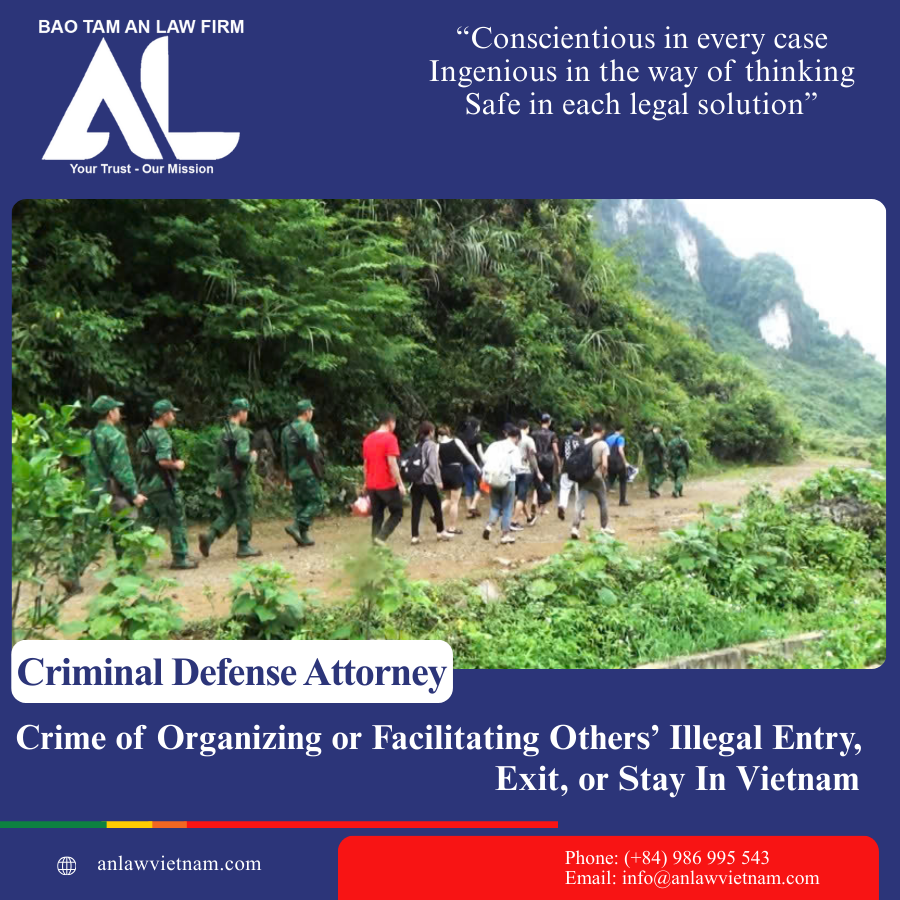
Crime of Organizing or Facilitating Others’ Illegal Entry, Exit, or Stay In Vietnam — Detailed Analysis (Updated 2025)
The phenomenon of illegal entry and exit in Vietnam has existed for a long time and has become increasingly complex, particularly in recent years.
Among the affected are clients of An Law Vietnam – Criminal Law Firm, who, having been lured or trapped by malicious actors, were induced to enter Vietnam illegally in various ways — for example, by using footpaths in border areas, or by using fake passports/visas, or passports/visas issued for the wrong purpose or to the wrong person. Many only realized they had been trapped after Vietnamese authorities temporarily detained them.
Therefore, in this article An Law Vietnam – Criminal Law Firm provides a comprehensive analysis of the penalties for the crime of organizing or facilitating others to enter, exit, or remain in Vietnam illegally, pursuant to the latest regulations in 2025.
Frequently asked questions from clients investigated for illegal entry and exit
Below are five questions An Law Vietnam – Criminal Law Firm in Vietnam regularly receives from clients:
➟ What constitutes illegal entry and exit?
➟ What related provisions apply under the immigration laws?
➟ Analysis of Article 348 of the Penal Code and the elements of the offense?
➟ What penalty ranges apply from 2025?
➟ How is evidence typically proven during investigation?
What is illegal entry and exit?
Definition | What is illegal entry/exit?
Illegal entry and exit consists of acts such as:
➤ Crossing the border without using an authorized border checkpoint or without completing required border procedures;
➤ Not having a valid passport/travel document/visa;
➤ Using forged documents;
➤ Intentionally evading border inspection or border-control authorities, or the police;
➤ Overstaying a visa while intentionally concealing residential information;
➤ Using fake passports, forged documents, or documents issued for an improper purpose or to the wrong subject.
In practice:
Some clients of An Law Vietnam – Criminal Law Firm have been sanctioned for facilitating fake tourist visas, for introducing contacts or agents who produce visas that do not comply with Vietnamese law, or for entering the country via border trails — in many cases clients did not realize these acts were serious violations of Vietnamese law until they were temporarily arrested and detained for investigation.
Relevant provisions under the immigration laws
Clause 2, Article 2 of the Law on Exit and Entry of Vietnamese Citizens 2019 (as amended and supplemented in 2023) explains:
➟ “Entry” means the act by which Vietnamese citizens come from abroad into the territory of Vietnam through Vietnam’s border checkpoints.
➟ “Exit” means the act by which Vietnamese citizens depart the territory of Vietnam through Vietnam’s border checkpoints.
“Acts of illegal entry and exit” are acts of entering Vietnam from outside its borders, or leaving Vietnam for abroad, in violation of the entry/exit regulations of the Socialist Republic of Vietnam. Illegal entry and exit is socially dangerous and infringes the State’s regulatory regime in the field of exit and entry.
Pursuant to the Law on Exit and Entry of Vietnamese Citizens 2019 (as amended and supplemented in 2023), the act of “illegally exiting or entering; organizing, brokering, assisting, harboring, concealing, or creating conditions for others to illegally exit or enter; or crossing the national border without completing prescribed procedures” is one of the serious prohibited acts specified in Article 4 of that Law.
Are persons who organize/facilitate illegal entry or exit subject to administrative or criminal sanctions?
→ It depends on factors such as whether there is an intent to obtain profit, the number of people involved, the amount of profit obtained, and whether the act was organized. Criminal prosecution may be initiated if any of these factors is met.
Typical aggravating factors:
➤ There is profit (receiving money, price difference, remuneration).
➤ The act is organized (role assignments, a guide, renting premises, receiving money).
➤ The offense is committed repeatedly.
➤ Large number of people involved (from 5 people or more).
➤ Unlawful gains of VND 100 million or more.
Analysis of Article 348 of the Penal Code and the elements of the offense
Article 348 is the provision carrying the most severe penalties in this area, especially where there is organization, large profits, or numerous persons involved. (Article 348 — Penal Code 2015, amended in 2017.)
Analysis of Article 348 — Elements of the offense
Acts subject to sanction
Article 348 comprises four groups of conduct:
- Organizing others to leave the country illegally;
- Organizing others to enter the country illegally;
- Organizing foreigners to remain in Vietnam unlawfully;
- Brokering (facilitating) others to carry out the above acts for profit.
Essential elements
➤ Having an intent to obtain profit (collecting money, price differences, receiving remuneration);
➤ The act is intentional;
➤ The offense is complete as soon as the act of organizing/facilitating is carried out — it is not necessary to wait until the person actually succeeds in entering or exiting.
Aggravating elements
➤ Committed in an organized manner (role assignment);
➤ Abuse of position and power;
➤ Committed repeatedly;
➤ Large number of persons involved;
➤ High unlawful gains;
➤ Causing death (even indirectly).
Criminal proceedings
Detailed penalty brackets under Article 348 — Organizing/facilitating illegal entry, exit, or stay
Bracket 1 — Clause 1, Article 348 ⇒ Imprisonment from 1 to 5 years.
Applies to ordinary offenses:
➤ There is profit but the profit is small;
➤ Small number of persons involved;
➤ No organized structure;
➤ No special aggravating circumstances.
Bracket 2 — Clause 2, Article 348 ⇒ Imprisonment from 5 to 10 years.
Applies when any one of the following circumstances exists:
➤ The act is organized;
➤ The offense is committed two times or more;
➤ Organizing/facilitating for 5 to under 11 persons;
➤ Unlawful gains from VND 100 million to under VND 500 million;
➤ Abuse of position and power;
➤ Dangerous recidivism.
⟹ This bracket is intended for professional, large-scale, organized cases.
Bracket 3 — Clause 3, Article 348 ⇒ Imprisonment from 7 to 15 years.
Applies when any one of the following particularly serious factors exists:
➤ Organizing/facilitating for 11 persons or more;
➤ Unlawful gains of VND 500 million or more;
➤ Causing death (as an indirect consequence).
⟹ This is the maximum penalty under Article 348.
Administrative sanctions
(When the elements do not reach the threshold of a criminal offense)
Administrative measures apply when:
➤ There is no intent to obtain profit;
➤ The act is not organized;
➤ The act is not repeated;
➤ The profit is below the criminal threshold (usually < VND 100 million).
Fines: From VND 5 million to VND 50 million, plus:
➤ Confiscation of means of transport and related objects;
➤ Deportation (if the violator is a foreign national).
Quick summary table
Case | Processing |
No profit, no organization, no recidivism | Administrative fine VND 5–50 million |
Profit / organized / 5 or more persons / profit ≥ VND 100 million | Criminal prosecution under Article 348 of the Penal Code |
Profit ≥ VND 500 million or 11 persons or more | Highest penalty bracket: 7–15 years’ imprisonment |
Legal framework regulating immigration-related conduct
- ⇗ Law on Exit and Entry of Vietnamese Citizens 2019 (amended and supplemented 2023)
- ⇗ Law on Entry, Exit, Transit and Residence of Foreigners in Vietnam 2014 (amended 2019).
- National Border Law 2003.
- ⇗ Penal Code 2015 (amended 2017) – Articles 347, 348, 349, 350.
- ⇗ Decree 144/2021/ND-CP and its replacing decree in 2025 (regulations on administrative sanctions in the field of entry and exit).
Related offenses in the Penal Code
Article | Content |
Article 347 | Violations of regulations on exit and entry; remaining in Vietnam illegally |
Article 348 | Organizing or facilitating others to illegally exit, enter, or remain in Vietnam |
Article 349 | Organizing or facilitating others to flee abroad or remain abroad illegally |
Article 350 | Forcing others to flee abroad or remain abroad illegally |
Evidence analysis in investigative practice
Proving the “profit” element
Investigative agencies will examine/interrogate:
➤ Bank transfers, messages negotiating price;
➤ Evidence of price differences for rented premises;
➤ Testimony of the person who received the brokerage service;
➤ Phone data, CCTV footage, geolocation.
Proving “organized” conduct
No written contract is necessary; it is sufficient to show:
➤ The presence of a guide;
➤ Someone who rents premises;
➤ Someone who receives money;
➤ Someone who transports or hands over clients.
→ These facts suffice to demonstrate “role assignment.”
Proving that the suspect “knew it was illegal” but still committed the act
Investigative agencies will compare:
➤ Failure to register temporary residence;
➤ Residents without passports/visas;
➤ Unusual cash transactions;
➤ Operating at late night hours, evading inspections.
An Law Vietnam perspective:
In many cases handled by An Law Vietnam – Criminal Law Firm, particularly those involving Overstay-related services, fake passports, or other forged documents, analysis of telephone evidence, travel history, evidence of money transfers and receipts, as well as links to criminal networks, are decisive factors in mitigating or excluding criminal liability for the accused. Defendants should contact a lawyer as early as possible to review the legality of the evidence and to protect procedural rights from the investigation stage.
Prevention checklist for violations of Article 348 (for landlords, homestay owners, and rental units)
Item | Must do | Purpose |
1. Document check | Ensure passport validity, visa, entry stamp | Verify lawful residence |
2. Check visa duration | Compare date of entry to visa expiration date | Prevent unlawful stays |
3. Keep records | Copy of passport, lease agreement | Evidence of innocence in case of investigation |
4. Declare temporary residence | Within 12–24 hours, online or to ward police | Mandatory legal obligation |
5. Manage number of occupants | Do not allow people to stay without registration | Avoid being classified as “illegal accommodation organizer” |
6. Monitor abnormal behavior | Full cash payments, late-night activity… | Prevent criminal risk |
7. Notify authorities | When suspecting illegal entrants | Important mitigating circumstance |
8. Do not broker or introduce | Do not refer guests to brokerage groups | Avoid being accused as accomplice |

Hanoi case (2024): organizing foreigners to stay illegally (⇗ source: cand.com.vn)
➟ Lê Văn Long and Wang Lanpei rented 7 apartments to 24 Chinese nationals.
➟ Many persons lacked valid passports/visas.
➟ Long earned a difference of VND 3 million per unit per month.
Result:
➟Wang Lanpei: 15 months’ imprisonment.
➟ Lê Văn Long: 15 months’ imprisonment with a suspended sentence.
Lesson:
→ Merely providing accommodation and collecting the price difference can constitute the crime of organizing illegal residence.
Why should foreigners have a lawyer immediately upon being detained for illegal entry?
The crime of organizing or facilitating others to illegally enter, exit, or remain in the country is strictly prosecuted in Vietnam. Even small acts such as allowing someone to stay with you, accepting a price difference, or failing to declare temporary residence can be indicators of a criminal offense.
Foreigners detained for overstaying, using fake passports, or suspected of involvement with illegal entry rings often face major difficulties when dealing with investigative agencies. Because of diplomatic and consular complexities, the links among actors may be hidden in third countries (intermediary areas), and investigations typically take longer than ordinary cases due to consular and diplomatic procedures. Therefore:
Reasons to secure immediate legal counsel:
➤ Lawyers help protect civil rights and access investigative files and testimony.
➤ Provide psychological reassurance to ensure truthful and accurate testimony and to coordinate effectively with investigative authorities during initial interrogations.
➤ Identify which evidence can exclude criminal liability and which evidence is more likely to lead only to administrative penalties.
➤ Provide Vietnamese–English explanations to avoid misunderstandings in statements that might lead to criminal proceedings.
➤ Develop a defense strategy in cases involving fake passports or overstay-related matters in Vietnam.
With many years of experience advising and defending in cases related to illegal entry/exit, fake passports/visas, and passports/visas issued for improper purposes or to improper subjects, An Law Vietnam — Criminal Law Firm understands that each client faces substantial legal pressure and that finding the correct solution while under investigation and temporary detention is challenging.
Core values of An Law Vietnam’s defense strategy:
At An Law Vietnam – Criminal Law Firm, we do more than simply review case files. We connect and update information about detained relatives, health, mental state, and case details; we conduct in-depth research into each “detail”, each “testimony”, and each “piece of evidence”, and together with applicable Vietnamese law, we develop a defense strategy that is “practical and appropriate” to each case. Our goal is to ensure that every legal decision and every statement we make in court delivers the “most optimal benefit” to clients who come to An Law Vietnam.
Specialized service and absolute confidentiality for every client:
We are proud to provide strategic defense services and absolute confidentiality to the expatriate community in Vietnam. Client confidentiality is our top priority, and the legal value we provide is our commitment.
DON’T WASTE PRECIOUS TIME! Any delay may adversely affect the case.
An Law Vietnam is committed to accompanying you, analyzing your file, providing optimal legal strategy, and offering comprehensive support to protect your legitimate rights.
Please contact our lawyers immediately for advice:
📞 Phone: (+84) 986 995 543
📧 Email: info@anlawvietnam.com
📍 Head office: Diamond Plaza, 34 Lê Duẩn, Sài Gòn Ward, Ho Chi Minh City
🏢 Vung Tau Branch: Võ Thị Sáu, Vung Tau Ward, Ho Chi Minh City
Related Articles:
Using a Counterfeit Passport: Forms of Punishment & Regulations to Understand (Updated 2025)
Temporary Residence Card – What You Need To Know
Procedures For Applying For Visa To Vietnam
Types of Vietnam VISA
Procedures for Applying for Work Permits for Foreigners Working in Vietnam
Expanding Conditions for Applying for Work Permits for Foreigners
Extension of Temporary Residence for Foreigners | Detailed Comparison between NA5 (Extension) and NA8 (New TRC Issuance)
Summary of Decree No. 282/2025/ND-CP | Analysis 1
Summary of Decree No. 282/2025/ND-CP | Analysis 2