

Vietnam Approves Revised Law on Investment (89.85% Approval Rate) | Key Changes Reshaping FDI and Market Access in the 2026–2035 Period
The Revised Law on Investment, Approved by 89.85% of Delegates – Crucial Changes Foreign Investors Need to Know
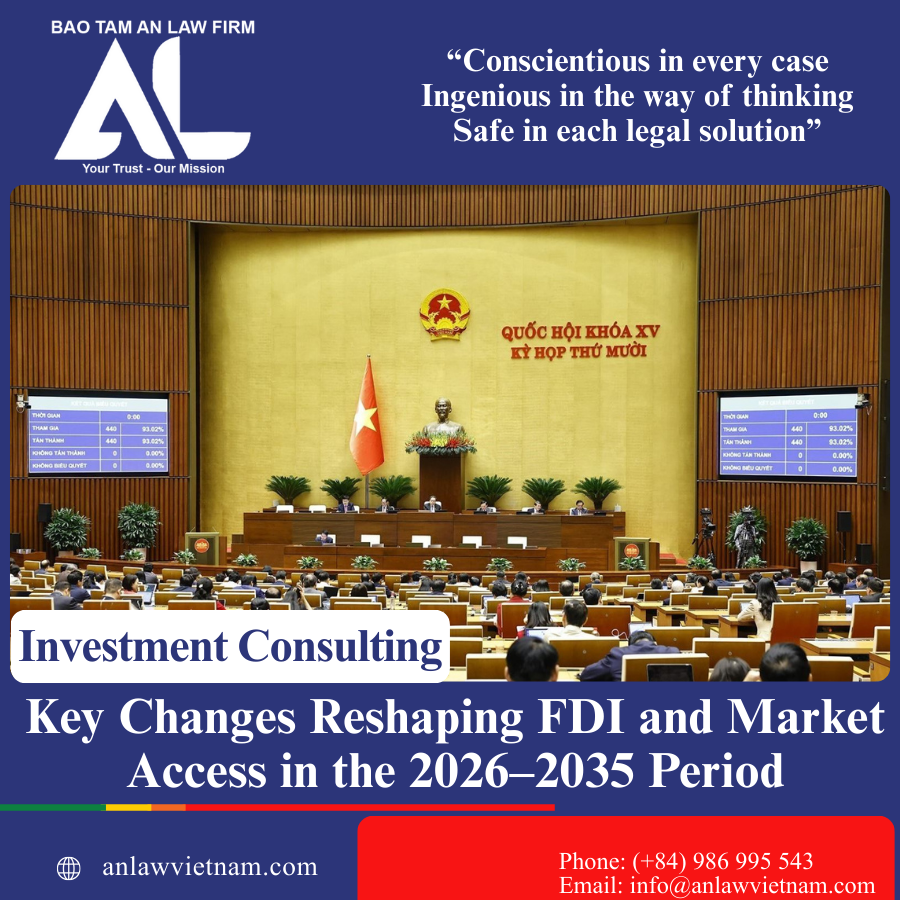
On the morning of 11 December 2025, during the continuation of the 10th Session, the 15th National Assembly voted to adopt the Revised Law on Investment, with 425 out of 436 delegates (89.85%) in favor. This marks a significant legal shift that restructures investment procedures and the regulatory list of conditional business activities.
The Revised Law streamlines pre-approval procedures (notably permitting the establishment of an enterprise prior to issuance of the Investment Registration Certificate (IRC)), reclassifies business sectors on a risk-based basis, and further opens market access to higher-quality FDI. These reforms shorten market-entry timelines, optimise compliance costs and enhance regulatory predictability for foreign investors.
Concurrently, the Law strengthens supervision in sensitive sectors (national security, data governance and defence) and tightens foreign-exchange controls to protect national financial stability.
Clearly, these changes present an opportunity for investors to reposition their investment strategies in Vietnam — faster market entry, but stricter compliance in high-risk areas. An Law Vietnam — Investment Consulting invites you to review the full details of the Revised Law on Investment.
The New Law comprises
➜ 7 Chapters
➜ 52 Articles
➜ 4 Appendices
This is a deep, restructuring amendment with direct impact on foreign investors, multinational groups and FDI enterprises in Vietnam — particularly as the country reorients its business environment toward transparency – simplification – selective attraction of high-quality FDI.

Most Important Content of the Revised Law on Investment
1). Narrowing the Scope of Investment Policy Approval
(approval/issuance of an Investment Registration Certificate — IRC)
The Revised Law substantially narrows the category of projects that must obtain State approval of investment policy (i.e., projects that require a prior Investment Registration Certificate). Going forward, the requirement will apply only to sectors the State identifies as strategic, sensitive, or likely to have a material impact on national security or national interests.
The objective is to reduce unnecessary pre-approval in sectors where such control is not warranted.
The groups of projects that continue to require Investment Policy Approval include:
➤ Seaports, airports: → strategic infrastructure that directly affects national logistics, sovereignty and transport security.
➤ Telecommunications, publishing, press: → activities touching the national communications system, data and information sovereignty.
➤ Projects in defence- and security-sensitive areas: → including border zones, military-adjacent areas and other strategically critical regions.
➤ Sectors with potential to affect data sovereignty & communication security:
➟ Example: data centres, critical digital infrastructure, technology platforms capable of large-scale data collection and processing.
In essence:
The new Law distinguishes two categories:
➤ Projects requiring approval (high-risk → subject to strict control)
➤ Projects exempt from approval (lower-risk → enterprises enjoy greater autonomy)
This shift removes the prior “everyone must apply” approach that prolonged investment preparation.
Implications for foreign investors
(1) Significant reduction in time to commence projects
Previously, many projects took 3–6 months to complete investment policy approval even where they were not in sensitive sectors. The Revised Law enables investors to:
➟ Enter the market more quickly
➟ Reduce approval waiting times
➟ Accelerate project implementation
(2) Lower compliance and legal costs
Administrative burdens such as:
➟ Application dossiers
➟ Opinions from multiple ministries
➟ Licensing procedures
→ are reduced through an exclusionary approach rather than wide-ranging mandatory lists.
(3) Improved transparency and predictability of the legal framework
With clearer scope definitions:
➟ Investors can determine from the outset whether their projects require approval.
➟ Regulators can concentrate resources on genuinely high-risk projects.
This delivers:
➟ A more predictable investment environment
➟ Greater transparency
➟ Reduced risk of ad-hoc interpretation by authorities
In Summary: The Revised Law on Investment provides that only strategic or sensitive projects require State approval (IRC). All other projects are exempt from this administrative step, materially reducing time-to-market and compliance costs for foreign investors.
2). Incentivised Sectors & Conditional Business Lines (reclassified)
The Revised Law undertakes a comprehensive restructuring of the catalogue of conditional business activities, with the objectives of reducing pre-approval burdens, expanding commercial freedom, and transitioning to a risk-based regulatory model. This reform implements the direction set out in Resolution 68 and Resolution 198 of the National Assembly.
Three major amendments:
Cutting 38 conditional business lines
The removal of 38 sectors from the conditional list:
➟ Reduces administrative burden
➟ Narrows the scope of conditional regulation to genuinely high-risk sectors
➟ Upholds the principle of “control only where necessary”
Adjusting the scope of the remaining 20 sectors
Beyond numeric reduction, the Law:
➟ Clarifies the boundaries of permissible activities
➟ Removes formalistic, overlapping or impractical conditions
➟ Converts many requirements from pre-approval to public disclosure and self-certification
This improves transparency and reduces arbitrary local application of rules.
Reclassification into two regulatory groups
(1) Sectors requiring pre-licensing / certification
Applies to high-risk sectors affecting public interest, national security or the financial system, including:
➟ Healthcare & public health — e.g., trading vaccines, medical devices, clinics and medical services with direct implications for human life.
➟ Environment — activities posing pollution risk, waste treatment, or large-emission projects.
➟ Security & data — data centres, critical digital infrastructure, and platforms that collect/process user data at scale.
➟ Finance & energy — banking, certain fintech activities with elevated risk, large-scale energy projects, and activities involving national resources.
Nature of this group: Investors must obtain licences prior to commencing operations to control risks at the outset.
(2) Sectors shifting to ex-post supervision
This is the most consequential change for foreign investors. Key features:
➟ No requirement for pre-business licensing in many cases
➟ Enterprises self-declare compliance with statutory conditions
➟ Regulatory agencies conduct inspections afterwards on a risk-based basis
➟ Sanctions apply where enterprises fail to meet required standards during operation
This model, common among OECD jurisdictions, helps to:
➟ Shorten business start-up timelines
➟ Reduce procedural costs
➟ Foster a more flexible and level competitive environment
➟ Encourage corporate self-compliance and accountability
Implications for foreign investors
- Material reduction in market-entry barriers ➦ FDI enterprises can commence operations earlier without lengthy pre-approval delays.
- Increased competitiveness and attractiveness of Vietnam ➦ Vietnam aligns more closely with regulatory models in Singapore, the EU and Japan — focusing on risk monitoring rather than procedural bottlenecks.
- Optimised compliance time and costs ➦ Particularly important for multinational groups that require rapid project roll-out.
- A more transparent and predictable legal environment ➦ Investors can assess legal implications at the strategy-formulation stage.
In Summary: The Revised Law removes 38 conditional business lines and restructures 20 others, categorising regulated sectors into: (i) pre-licensing for high-risk areas (healthcare, environment, data security, finance/energy) and (ii) ex-post supervision for lower-risk areas — thereby significantly lowering market-entry barriers for foreign investors.
3). Foreign Investors May Establish Enterprises Prior to Obtaining an IRC
This change is widely regarded as the most significant innovation in the Revised Law, fundamentally altering the sequence of investment procedures and substantially lowering market-entry obstacles for foreign investors in Vietnam.
Fundamental change in procedural order
Previously (old mechanism):
- Apply for IRC (Investment Registration Certificate)
- Apply for ERC (Enterprise Registration Certificate)
- Establish the enterprise
➦ This pre-licensing model aimed to control investors from the outset, but in practice IRC processing often required 30–45 days (or longer for complex projects), generating delay risks and high opportunity costs for FDI.
Under the Revised Law the sequence becomes: ERC → IRC
The legal framework now permits the formation of an enterprise with foreign investment before completion of IRC procedures. In other words, investors obtain legal standing as an enterprise at the outset without awaiting IRC issuance.
This approach mirrors practice in developed investment jurisdictions (e.g., Singapore, Hong Kong, the EU), where corporate formation is expedited while investment activities are supervised through reporting obligations and compliance conditions.
Positive impacts for foreign investors
Shortens administrative timelines by at least 30–45 days
By allowing enterprise formation prior to IRC issuance, investors can:
➟ Sign office leases
➟ Open bank accounts
➟ Recruit personnel
➟ Execute preliminary commercial agreements and procure goods
…while the IRC application is being processed.
Reduces risk of project delay
Previously, projects could be stalled for weeks if the IRC required clarification or additional review. Enterprises can now proceed in parallel with IRC formalities.
Enhances Vietnam’s attractiveness for FDI
Vietnam moves toward the cohort of markets with faster, more flexible entry processes — an advantage for:
➟ Technology companies
➟ Investment funds
➟ Manufacturers relocating supply chains
➟ Cross-border M&A
Accompanying Security & Market Access Conditions
While opening procedures, Vietnam imposes early controls to protect national security and sustain quality FDI. Investors must comply with:
Reporting obligations prior to operational deployment
Competent authorities have the power to request activity reports from newly established enterprises to:
➟ Prevent the creation of dormant “shell” companies
➟ Monitor inbound and outbound capital flows
➟ Track projects that could affect economic security
Market access conditions at the enterprise formation stage
Investors must demonstrate:
➟ That their proposed activities fall within permitted investment sectors
➟ That they are not subject to market access restrictions or prohibitions
➟ Compliance with conditions relating to ownership ratios, local partners, investment form and scope of activities
Thus, establishment is permitted first, but enterprises must observe the FDI legal framework from the outset.
Enhanced control over transactions in sensitive locations
Transactions concerning border areas, islands, coastal zones and national-defence critical sites remain subject to special monitoring. This prevents abuse of the “establish-first, IRC-later” sequence to acquire sensitive assets.
Policy message: “Open but selective”
Vietnam is transitioning toward a policy that:
➟ Expands commercial freedom
➟ Facilitates attraction of high-quality FDI
➟ Strengthens risk management in sensitive sectors
Conclusion: The Revised Law not only expedites procedures but also seeks to improve the quality of FDI by selecting investors aligned with sustainable development and national security objectives.
4). Outward Investment Management – Significant Simplification
The Revised Law introduces one of the most substantial reforms to date regarding Vietnamese enterprises’ outward investment. The reform aims to:
➟ Maximise facilitation for Vietnamese enterprises expanding abroad
➟ Concurrently strengthen controls on foreign-exchange risks, cross-border transfers and economic security
The new framework brings Vietnam closer to modern international investment management practices: more streamlined procedures combined with stricter oversight of capital sources and cash flows.
Key elements:
Abolition of outward investment policy approval
Previously, many outward investment projects required policy approval by the National Assembly, the Prime Minister or the Ministry of Planning and Investment — causing protracted processing, opportunity costs and delays to corporate expansion plans. The Revised Law removes this approval requirement and replaces it with a streamlined, risk-based system.
Narrowing the scope of projects requiring an outward investment registration certificate
Only large-scale projects or those presenting particular risk factors will now require a certificate. Small-scale, low-value or ordinary commercial outward investments will typically be subject only to reporting obligations. This change allows enterprises to:
➟ Save time
➟ Reduce procedural burdens
➟ Lower legal and compliance costs
Increased autonomy for Vietnamese enterprises
Enterprises are empowered to:
➟ Independently decide timing, form and strategy for outward investment
➟ Implement projects prior to completion of all formalities
➟ Adjust scale or sectoral focus without repeated licensing procedures
This represents a major step toward a flexible business environment aligned with OECD practice.
Tightening foreign-exchange controls to prevent illicit transfers
While procedural burdens are eased, the Law strengthens monitoring of capital flows, particularly regarding:
➟ Outbound transfers presented as investment but intended to move funds illicitly
➟ Projects exhibiting signs of transfer-pricing or concealment of cash flows
➟ Investments into high-risk jurisdictions or counterparties
The new regime requires:
➟ Periodic reporting of cash flows
➟ Justification of investment purpose where suspicion arises
➟ Compliance with foreign-exchange regulations and national risk-management measures
Objective:
➡ Prevent misuse of investment mechanisms for illicit transfers or tax evasion.
➡ Protect national financial stability.
Impact on enterprises
Reduced procedures – accelerated market expansion:
With abolition of outward investment policy approval and narrower certificate requirements, enterprises can:
➟ Incorporate foreign legal entities more quickly
➟ Facilitate cross-border M&A
➟ Run international projects concurrently with domestic operations
Investment timelines may fall from several months to a few weeks.
Balancing facilitation and national financial security
The regime pursues a dual objective:
1). Facilitation: reduce licences and dossiers, increase flexibility and support corporate internationalisation.
2). National financial security: control outward capital flows, reduce abuse risks and ensure foreign-exchange compliance.
In Summary: The Revised Law eliminates investment policy approval for outward investment, narrows the category of projects requiring outward investment certificates, increases corporate autonomy and tightens foreign-exchange controls — thereby promoting expansion while protecting national financial security.
Other Important Review Contents
1). Inclusion of provisions related to the Law on Railways
The addition of railway-related provisions within the Revised Law aims to ensure:
Avoidance of legal conflict between laws
Railways are governed by the Law on Railways and numerous technical regulations. Amendments in the Investment Law must therefore be cross-checked to avoid inconsistencies concerning:
➟ Project approval authority
➟ Investor selection conditions
➟ Forms of investment (State – PPP – private)
This prevents project standstill caused by divergent provisions across statutes.
Harmonisation of project approval authority
Large-scale railway infrastructure projects often require high-level approvals. The Revised Law seeks to:
➟ Standardise approval procedures
➟ Avoid overlap between the Ministry of Transport, the Ministry of Planning and Investment and the People’s Committees
➟ Create a consistent legal corridor for urban railway and high-speed rail projects
Preservation of technical and safety standards
Rail projects require stringent technical standards, operational safety and special public asset management. Integration into the Investment Law must preserve these technical specifics rather than diluting them under general investment procedures.
2). Unifying investment approval regulations across multiple laws
A central cause of prolonged project timelines has been the “one project – many procedures – many agencies” situation. A single real-estate or infrastructure project may be concurrently subject to:
➟ Law on Investment
➟ Law on Land
➟ Law on Housing
➟ Law on Real Estate Business
➟ Law on Bidding
➟ Law on Planning
Each statute previously required distinct approvals, leading to duplication, conflict and protracted processing.
This review aims to:
➟ Identify the single, controlling procedure where appropriate
➟ Eliminate overlapping procedures between laws
➟ Reassign authority coherently
Result: Enterprises need to undertake one consolidated investment approval procedure, significantly reducing time and cost.
3). Continued prohibition on trading: cigarettes & heated tobacco products
The Revised Law maintains the prohibition on trading conventional cigarettes and heated tobacco products.
Rationale:
Consistency with the national health policy
➟ Reduce smoking prevalence
➟ Lower disease burden
➟ Align with international tobacco-control obligations
Preventing market entry of novel addictive products
Heated tobacco is a relatively new product and has not been licensed in Vietnam. Maintaining the ban reduces the risk of market penetration through advertising, e-commerce or hand-carriage.
Impact on investors: Projects involving new-generation tobacco products remain barred from the Vietnamese market.
4). Review of regulations applicable to real-estate projects
Real-estate projects are the most heavily regulated category and frequently experience:
➟ Legal conflicts
➟ Procedural overlap
➟ Local approval bottlenecks
This review focuses on three objectives:
Addressing overlap among the Law on Land, the Law on Housing and the Law on Investment
Examples:
➟ Investment policy approval
➟ Decisions on land-use purpose and allocation
➟ Project objective definitions
➟ Conditions for transfer
New regulations aim to create a unified legal interface to prevent divergent agency interpretations.
Reducing legal risk for investors
With harmonised legal rules, investors can:
➟ Predict obligations with greater accuracy
➟ Plan financial and legal strategies effectively
➟ Lower the risk of project suspension due to legal disputes
Resolving procedural bottlenecks for large real-estate projects
Many housing, industrial park and urban development projects have been delayed due to:
➟ Unclear procedure types
➟ Conflicts over authority
➟ Uncertain transfer/land-allocation conditions
The Revised Law facilitates:
➟ Faster approvals
➟ Greater transparency
➟ Support for market recovery
An Law Vietnam overall assessment | in Summary of Other Review Contents: The Revised Law harmonises conflicting provisions among sectoral statutes, reinforces public-health and safety policies by maintaining tobacco prohibitions, integrates railway-related provisions without compromising technical standards, and addresses legal bottlenecks for large real-estate projects by removing overlap with land and housing laws.
Overall Significance of the Revised Law on Investment
The Revised Law on Investment is not a mere technical update; it is a reform intended to reshape Vietnam’s investment ecosystem over the 2026–2035 period. It constitutes a strategic move to modernise the legal environment, enhance national competitiveness and support sustainable development amid rapid global economic shifts.
Institutionalising key reform directives
The new Law aligns with major resolutions such as:
➟ Resolution 68 — administrative-procedure reform and investment-climate improvement
➟ Resolution 198 — legal-system refinement
It also supports a selective FDI strategy, prioritising high-technology, innovation, and regional manufacturing/service hubs.
This demonstrates a consistent policy of:
➟ Shifting from quantity-led growth to quality-focused investment
➟ Opening markets while controlling systemic risks
➟ Balancing investment attraction with protection of national interests
Creating a transparent – modern – predictable investment environment
Predictability is a core investor expectation. The substantive amendments deliver:
➟ Removal of overlaps among Land – Housing – Investment – Railway – Bidding laws
➟ Clearer definitions of prohibited/restricted and incentivised sectors
➟ Streamlined approval procedures
➟ Transparent market-access conditions for foreign investors
Collectively, these changes move Vietnam toward a modern legal model comparable to regional peers such as Singapore, South Korea and Japan.
Reducing pre-licensing and increasing smart ex-post supervision
The Law transitions from heavy pre-licensing to risk-based ex-post supervision:
➟ Approval is required only for sensitive or high-risk projects
➟ Numerous early-stage procedures are eliminated
➟ Enterprises may commence business earlier while authorities focus on controlling data security, financial stability, environmental impact and defence-sensitive areas
This reform unlocks potential for both enterprises and regulatory agencies.
Enhancing the capacity to attract high-quality FDI
The Revised Law helps Vietnam to:
➟ Shorten market-entry time for FDI
➟ Clarify investment conditions
➟ Provide effective incentives for strategic sectors (technology, data, logistics, clean energy)
➟ Reduce legal risk in real-estate, infrastructure and PPP projects
These reforms are timely given global supply-chain realignment, the “Global” trend, and regional competition with Indonesia, Malaysia and the Philippines to attract high-tech and advanced manufacturing projects. The Revised Law is expected to strengthen Vietnam’s regional competitiveness.
Establishing a legal foundation for 2026–2035
The Revised Law lays a long-term foundation for:
➦ Digital economy & data: data centres, critical digital infrastructure, AI and Fintech platforms, electronic transactions.
➦ Industry – energy – supply chains: high-tech manufacturing, integrated supply chains, renewable energy and green infrastructure.
➦ Urbanisation & sustainable real estate: resolving legal bottlenecks, transparent project-approval mechanisms, support for mega-projects beyond 2030.
➦ Vietnamese enterprises investing abroad: supporting international expansion, capital-flow control and safeguarding national financial security.
The new Law will serve as the backbone of Vietnam’s growth strategy for the next decade.
An Law Vietnam lawyers’ assessment: The Revised Law on Investment modernises Vietnam’s investment legal framework, implements the Party’s reform agenda, enhances transparency and predictability, shifts from pre-approval to risk-based ex-post supervision, attracts high-quality FDI and establishes the legal platform for national development for 2026–2035.
With more than 20 years of experience supporting multinational corporations in market expansion and development in Vietnam, An Law Vietnam recognises that businesses require not only skilled lawyers but also advisors who can provide strategic guidance grounded in two core principles: Legal Compliance and Profit Maximisation.
With a seasoned professional team experienced in cross-border M&A, infrastructure, technology, construction, mining and commercial transactions — and with cross-border practice capability — we fully understand the legal changes following the National Assembly session, particularly the effects of the Revised Law on Investment and the Revised Law on Bankruptcy on your operations and projects.
We recognise that a shifting legal landscape may create material risks for international businesses — especially when operating large projects or entering the Vietnamese market for the first time. Accordingly, investors need a trusted legal partner who not only explains the law but helps FDI investors to make robust decisions to: “Seize the right trend, enter the right market, and implement with the right legal structure.”
Allow the An Law Vietnam Investment Consulting Team to provide you with end-to-end legal services:
➤ Review your investment strategy
➤ Analyse compliance under the New Investment Law
➤ Support FDI projects, M&A, enterprise incorporation, representative offices and branches in Vietnam
➤ Optimise legal and tax structures
➤ Advise on optimal labour-law procedures within the enterprise
Investment Consulting – An Law Vietnam | We don’t just analyse the law – we help businesses turn the new law into a competitive advantage for investment in Vietnam.
Contact Us An Law Vietnam
📞 Phone: (+84) 986 995 543
📧 Email: info@anlawvietnam.com
📍 Head Office: Diamond Plaza, 34 Le Duan Street, Sai Gon Ward, Ho Chi Minh City
🏢 Vung Tau Branch: Vo Thi Sau Street, Vung Tau Ward, Ho Chi Minh City